
Cyber Crimes
🔑 Key Takeaways & Definition
- ● Definition: Cyber Crime is defined as any unlawful act where a computer or communication device is used to commit or facilitate a crime.
- ● The Rule: If it involves a digital device and breaks the law, it is a cyber crime.
- ● Core Concept: The computer can be the Target (e.g., Hacking, Virus) or the Weapon (e.g., Cyberstalking, Credit Card Fraud).
Introduction
Cyber crime is no longer just about hacking; it has evolved into a complex ecosystem affecting individuals, businesses, and nations. From simple phishing emails to state-sponsored cyber warfare, the scope is vast.
In 2026, cyber criminals leverage:
- ● Artificial Intelligence to create deepfakes
- ● Cryptocurrency for anonymous payments
- ● Dark web marketplaces to sell stolen data
- ● Ransomware-as-a-Service to democratize attacks
The digital world offers unprecedented opportunities—but also unprecedented risks.
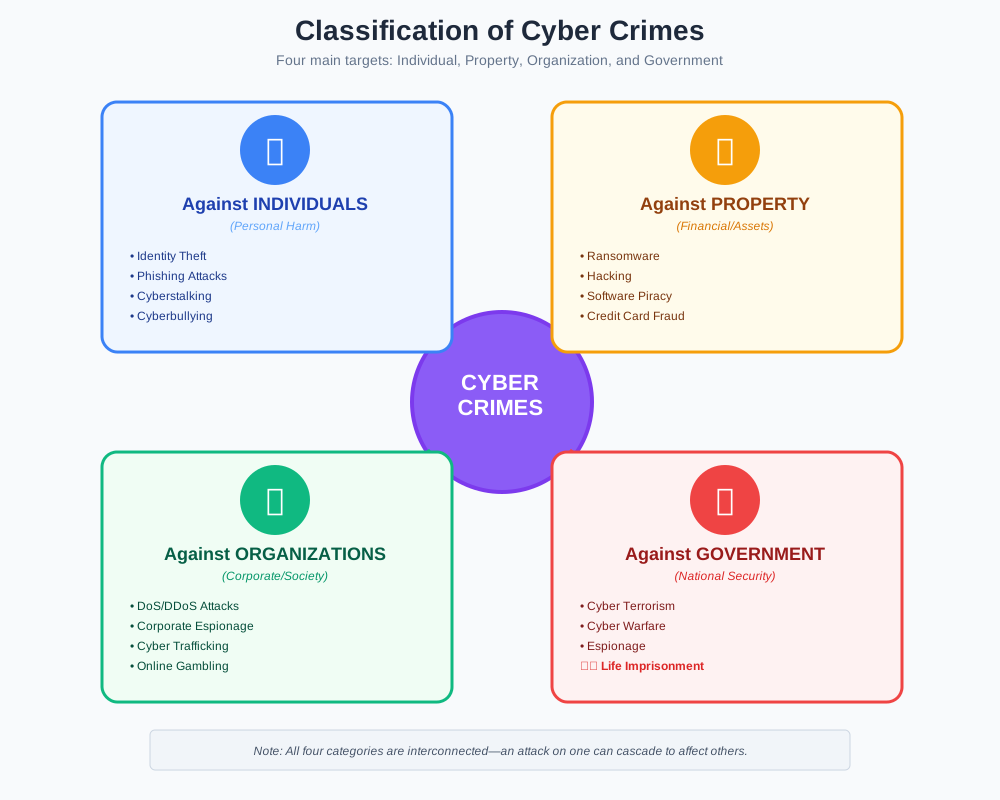
Classification of Cyber Crimes
Crimes are categorized by who they attack. This is the standard 4-part model for exams.
A. Against Individuals (Personal)
Crimes targeting specific people to cause financial or mental harm.
Identity Theft
Stealing personal data (Name, PAN, DOB) to impersonate someone else.
How it works:
- Hacker obtains your Aadhaar details
- Opens bank account in your name
- Takes loans, leaving you with debt
Real Example: A student's PAN was stolen, and the criminal filed fake tax returns, causing the victim to receive notices from Income Tax Department.
Phishing
Sending fake emails (e.g., "Bank Update") to trick users into revealing passwords.
Common Tactics:
- "Your account will be closed—click here to verify"
- Fake courier delivery notifications
- "You've won a lottery" scams
How to identify:
- Check sender email carefully (g00gle.com vs google.com)
- Banks NEVER ask for passwords via email
- Look for spelling/grammar mistakes
Real Example: 2025 HDFC phishing campaign stole credentials from 50,000 customers by mimicking official bank emails.
Cyberstalking
Repeatedly harassing or threatening a victim via emails, social media, or chat.
Warning Signs:
- Unwanted messages/calls
- Monitoring your online activity
- Threatening to harm you or family
- Creating fake profiles to contact you
Legal Protection: Section 66E of IT Act 2000 provides protection against privacy violations.
Cyberbullying
Posting humiliating content to harm a victim's reputation (common among students).
Examples:
- Sharing embarrassing photos without consent
- Creating fake profiles to defame someone
- Spreading rumors on social media
- Posting hate comments
Impact: Depression, anxiety, academic decline, even suicide in extreme cases.
B. Against Property (Financial/Assets)
Crimes targeting money, data, or intellectual property.
Ransomware
Malware that locks (encrypts) user files and demands money (Bitcoin) to unlock them.
How it works:
- You download malicious attachment
- Ransomware encrypts all your files
- Screen displays: "Pay $500 in Bitcoin to decrypt"
- Countdown timer creates urgency
Famous Examples:
- ● WannaCry (2017): Infected 200,000 computers in 150 countries
- ● Colonial Pipeline (2024): Shut down fuel distribution across U.S. East Coast
- ● REvil: Targeted large corporations with million-dollar ransoms
Defense: Regular backups stored offline defeat ransomware completely.
Hacking
Unauthorized entry into a system to steal data or destroy files.
Types:
- ● Ethical Hacking (White Hat): Authorized testing to find vulnerabilities
- ● Criminal Hacking (Black Hat): Illegal access for theft or destruction
- ● Gray Hat: Finds vulnerabilities without permission but doesn't exploit
Common Methods:
- SQL Injection
- Brute force password attacks
- Exploiting unpatched software vulnerabilities
Software Piracy
Illegal copying or distribution of copyrighted software, movies, or music.
Forms:
- Cracked software (Photoshop, MS Office)
- Torrenting movies/music
- Using keygen tools
Penalties: Section 67 of IT Act: 3-5 years jail + ₹5-10 lakh fine
Why it matters: Pirated software often contains malware.
C. Against Organizations (Corporate/Society)
Crimes targeting companies, groups, or society at large to disrupt services or steal trade secrets.
Denial of Service (DoS)
Flooding a company's server with traffic to crash their website and stop business.
How it works:
- ● Simple DoS: One attacker sends massive requests
- ● DDoS (Distributed): Botnet of thousands of infected computers attack simultaneously
- Server overwhelmed, legitimate users can't access
Impact:
- E-commerce sites lose revenue during downtime
- Banking services unavailable
- Reputation damage
Real Example: 2016 Dyn DDoS attack took down Twitter, Netflix, Reddit, PayPal using Mirai botnet.
Defense: Load balancing, DDoS mitigation services (Cloudflare, Akamai), rate limiting.
Corporate Espionage
Stealing trade secrets (like a new product design) from a rival company.
Methods:
- Social engineering to trick employees
- Malware on corporate networks
- Insider threats (disgruntled employees)
- Phishing executives for credentials
What's stolen:
- Product designs and blueprints
- Customer databases
- Financial strategies
- Research & Development data
- Merger/acquisition plans
Real Example: Chinese APT10 group stole intellectual property from aerospace and tech companies worldwide.
Cyber Trafficking
Using the dark web to traffic drugs, weapons, or humans.
How it operates:
- Anonymous marketplaces (Silk Road model)
- Cryptocurrency payments (Bitcoin, Monero)
- Encrypted communications
- International networks
Trafficked items:
- Illegal drugs
- Weapons and explosives
- Stolen data and credit cards
- Human trafficking (exploitation)
- Counterfeit documents
Law Enforcement: International cooperation required; FBI, Interpol work together.
Online Gambling
Operating illegal betting platforms that bypass national laws.
Why it's illegal:
- No regulation or oversight
- Money laundering conduit
- Addiction without protection
- Tax evasion
Forms:
- Offshore betting sites
- Illegal cricket/sports betting apps
- Online casinos without licenses
- Fantasy sports with real money
Penalties: Vary by jurisdiction; can include asset seizure and imprisonment.
D. Against Government (National Security)
Crimes threatening the sovereignty or safety of a nation.
Cyber Terrorism
Attacks on critical infrastructure (power grids, banking systems) to cause panic.
Targets:
- Electricity distribution networks
- Water treatment facilities
- Air traffic control systems
- Banking and financial systems
- Telecommunication networks
- Emergency services (911, ambulance)
Impact: Millions without power, contaminated water supply, flight cancellations, economic collapse, loss of life.
Legal Consequence: Life Imprisonment under Section 66F of IT Act 2000.
Cyber Warfare
Politically motivated hacking to sabotage another country's military or government systems.
Examples:
- ● Stuxnet (2010): U.S.-Israel cyberattack destroyed Iranian nuclear centrifuges
- ● NotPetya (2017): Russian attack on Ukraine caused $10 billion global damage
- ● SolarWinds (2020): Russian hackers infiltrated U.S. government agencies
Characteristics:
- State-sponsored APT (Advanced Persistent Threat) groups
- Long-term reconnaissance (months/years)
- Strategic timing (wartime, elections)
- Targets: military, intelligence, critical infrastructure, elections
Modern Reality: Cyber warfare is the "fifth domain" of warfare alongside land, sea, air, and space.
Emerging Threats (2026 Trends)
As technology evolves, so do the crimes. These are the modern threats you need to know for current exams.
.svg)
Deepfakes
Using AI to create fake videos or voice clones of a person (e.g., a CEO or family member) to authorize fraudulent transfers.
How it works:
- AI analyzes hundreds of photos/videos of target person
- Creates realistic video of them saying anything
- Criminal uses deepfake to:
- Authorize wire transfers
- Damage reputation
- Spread misinformation
Real Example (2024): A Hong Kong company lost $25 million when criminals used deepfake video of the CFO to authorize transfers in a video call.
Warning Signs:
- Unnatural facial movements
- Audio sync issues
- Lighting inconsistencies
- Request for unusual urgency
Cryptojacking
Hackers secretly use your computer's processing power (CPU) to mine cryptocurrency, slowing down your device.
How it works:
- Malicious code embedded in websites
- Runs in background without your knowledge
- Uses 80-90% of CPU power
- Criminal profits from mined cryptocurrency
Symptoms:
- Computer suddenly slow
- Fan running constantly
- High CPU usage (check Task Manager)
- Increased electricity bill
Prevention: Use ad blockers and browser extensions like NoCoin, MinerBlock.
Sextortion
Blackmailing victims by threatening to release intimate images unless paid.
Common Scenario:
- Scammer befriends victim on social media
- Convinces them to share intimate photos/videos
- Threatens to send to family/friends unless paid
- Demands increasing amounts
Legal Protection: Section 66E of IT Act: 3 years jail + ₹2 lakh fine for privacy violations.
If you're a victim:
- DO NOT pay (it never stops)
- Report to cybercrime.gov.in immediately
- Preserve all evidence (screenshots, messages)
- Contact local police
Legal Framework: The IT Act 2000 (India)
Memorize these Sections for your exam.
| Section | Offense | Penalty / Punishment |
|---|---|---|
| Sec 43 | Damage to Computer System Virus attacks Unauthorized access | Civil Liability: Compensation to victim |
| Sec 66 | Computer Related Offenses Dishonest hacking Fraudulent activities | 3 Years Jail OR ₹5 Lakh fine (or both) |
| Sec 66C | Identity Theft Using someone's password Digital signature fraud | 3 Years Jail + ₹1 Lakh fine |
| Sec 66D | Cheating by Personation Phishing attacks Impersonation fraud | 3 Years Jail + ₹1 Lakh fine |
| Sec 66E | Violation of Privacy Publishing private images Sextortion materials | 3 Years Jail + ₹2 Lakh fine |
| Sec 66F | Cyber Terrorism ⚠️ Threatening national unity Attacks on critical infrastructure | LIFE IMPRISONMENT (Most Severe Penalty) |
| Sec 67 | Publishing Obscene Info Pornography distribution | 3-5 Years Jail + ₹5-10 Lakh fine |
⚠️ Prevention & Safety Checklist
Practical steps to protect yourself:
- ● Enable MFA: Always use Multi-Factor Authentication (OTP/App) for logins. Even if hackers steal your password, they can't access your account without the second factor.
- ● Patch Your OS: Keep Windows/Android updated to block new malware. WannaCry exploited a Windows vulnerability that Microsoft had already patched—victims who didn't update were infected.
- ● Data Backups: Keep an offline copy of data to defeat Ransomware. Store on external hard drive disconnected from computer. Follow 3-2-1 rule: 3 copies, 2 different media types, 1 offsite.
- ● Verify Links: Hover over email links before clicking to spot Phishing (e.g., g00gle.com vs google.com). Check the actual URL in bottom-left corner of browser.
- ● Strong Passwords: Use complex passwords (e.g., Tr!ck#42) and never reuse them. Use password managers like Bitwarden, 1Password. Minimum 12 characters with mix of uppercase, lowercase, numbers, symbols.
Conclusion
Cyber crimes have evolved from simple viruses to sophisticated AI-driven attacks threatening individuals, businesses, and nations. Understanding the classification (Individual, Property, Organizations, Government), recognizing emerging threats (Deepfakes, Cryptojacking, Sextortion), and knowing the legal framework (IT Act 2000) are essential for protection.
Remember:
- ✅ Prevention is better than cure – Use MFA, strong passwords, backups
- ✅ The computer can be target OR weapon – Both scenarios are cyber crimes
- ✅ Report immediately – cybercrime.gov.in within 24-48 hours
- ✅ IT Act 2000 is your legal shield – Know your rights and penalties
- ✅ Stay updated – Threats evolve; continuous learning is essential
The digital world offers unlimited opportunities—but only if we navigate it safely. ðŸ”