
CIA Triad
🔑 Key Takeaways & Definition
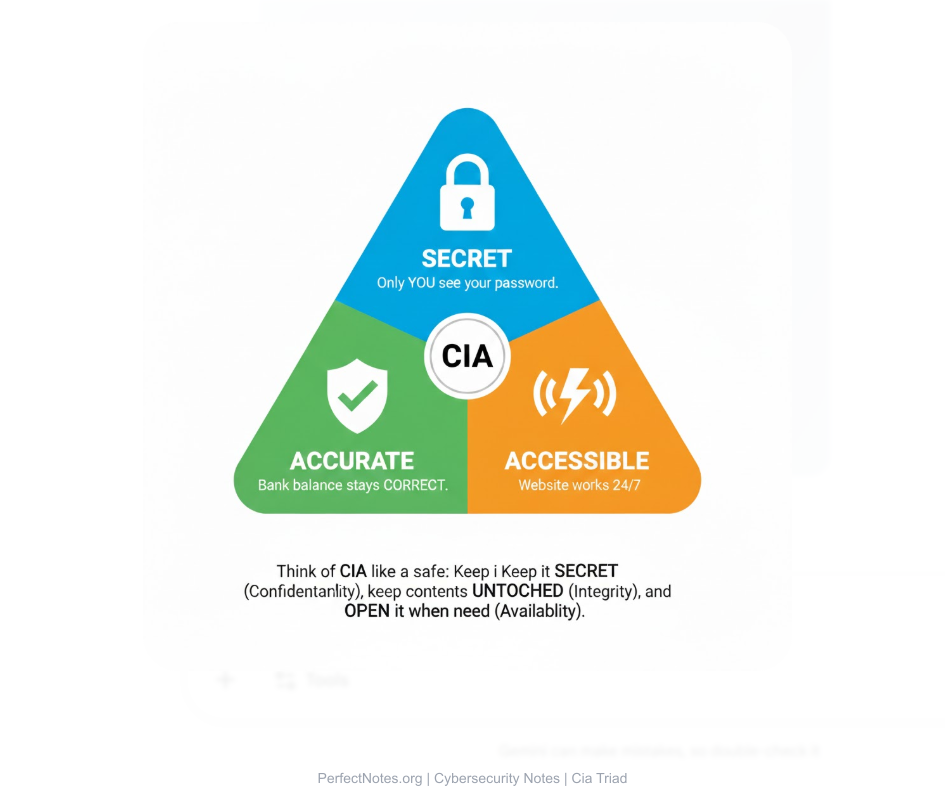
- ● Definition: The CIA Triad is a widely accepted information security model that guides policies for cybersecurity within an organization.
- ● The Components: Confidentiality, Integrity, and Availability.
- ● Core Concept: Security is not just about keeping secrets; it is about ensuring data is accurate and accessible when needed.
Introduction to CIA Triad
In the world of cybersecurity, the CIA Triad is the "North Star." It is the foundational model used to govern security policies. Every security control—from a password to a firewall—is designed to uphold one or more of these three principles.
The CIA Triad provides a simple yet comprehensive framework for evaluating and implementing security measures. When assessing any security decision, ask: "Does this protect Confidentiality, Integrity, or Availability?"
Confidentiality 🔒
Definition: Preserving authorized restrictions on information access and disclosure.
Goal
Ensure that sensitive information is accessed only by authorized persons. Think of it as "privacy"—keeping secrets safe from prying eyes.
Key Threats
- ● Snooping: Unauthorized individuals viewing sensitive data (e.g., shoulder surfing).
- ● Packet Sniffing: Intercepting network traffic to steal unencrypted data.
- ● Social Engineering: Manipulating people into revealing credentials (e.g., Phishing).
- ● Dumpster Diving: Searching through physical trash for sensitive documents.
- ● Data Breaches: Hacking databases to steal records (e.g., Equifax exposed 147M records).
Real-World Examples
Breach Example: The 2017 Equifax breach exposed personal information of 147 million people—names, Social Security numbers, birth dates, addresses, and credit card numbers. This was a massive confidentiality failure.
Success Example: Your email password protects the confidentiality of your private messages. Only you (and those you authorize) can read your emails.
Countermeasures
Encryption
Converting data into unreadable code (ciphertext) that can only be decrypted with the correct key.
Types:
- a. Symmetric Encryption: Uses a single key for both encryption and decryption (Speed: Fast, e.g., AES-256).
- b. Asymmetric Encryption: Uses a public key to encrypt and a private key to decrypt (Security: High, e.g., RSA).
Application:
- a. Data at Rest: Encrypting hard drives (AES-256).
- b. Data in Transit: Using HTTPS/TLS for web traffic.
Example: HTTPS encrypts web traffic so hackers on public Wi-Fi can't read your passwords.
Access Control (ACLs)
Using permissions (Read/Write/Execute) to limit who sees what.
Mechanisms:
- a. Role-Based Access Control (RBAC): Permissions based on job role.
- b. Attribute-Based Access Control (ABAC): Permissions based on attributes (location, time, device).
- c. Need-to-Know Principle: Only access what's necessary for your job.
Example: An accountant can view financial records, but not HR salary data.
Authentication
Verifying identity before granting access via MFA (Multi-Factor Authentication).
Authentication Factors:
- a. Something You Know: Password, PIN.
- b. Something You Have: Smart card, security token, SMS code.
- c. Something You Are: Biometrics (fingerprint, face recognition).
Example: Banking apps require both password (knowledge) and SMS code (possession).
Integrity ✅
Definition: Guarding against improper information modification or destruction.
Goal
Ensure that data is accurate, complete, and trustworthy—it has not been tampered with during transit or storage. Think of it as "trust"—can you rely on this data?
Key Threats
- ● Viruses & Malware: Corrupting or modifying files without authorization.
- ● Logic Bombs: Malicious code triggered by specific conditions (e.g., date, user action).
- ● Unauthorized Changes: Insiders altering data without permission.
- ● Data Corruption: Hardware failures or software bugs damaging data.
- ● SQL Injection: Attackers modifying database contents via malicious queries.
- ● Man-in-the-Middle Attacks: Intercepting and altering data in transit.
Real-World Examples
Breach Example: A student hacks the university database and changes their grade from 'F' to 'A'. This is an integrity violation—the academic record is no longer trustworthy.
Success Example: When you transfer $100 from your bank account, the system deducts exactly $100—not $10 or $1,000. The bank maintains integrity of transaction data.
Countermeasures
Hash Functions
Creating a digital fingerprint (checksum) of a file to verify it hasn't changed.
How It Works (Step-by-Step):
- ● Input: Run the original file through a hash algorithm (e.g., SHA-256).
- ● Generate: The system creates a unique "fingerprint" or hash value (e.g., a3b5c7...).
- ● Verify: Later, hash the file again.
- ● Compare: If the new hash matches the old hash, file integrity is verified.
Example: Software downloads include hash values—verify the hash after downloading to ensure the file wasn't tampered with.
Original File: document.pdf
Hash: a3b5c7d9e1f2a4b6c8d0e2f4a6b8c0d2
Downloaded File: document.pdf
Hash: a3b5c7d9e1f2a4b6c8d0e2f4a6b8c0d2 ✓ Match! File is authentic
Digital Signatures
Proves who sent the message and that it wasn't altered.
How It Works (Step-by-Step):
- ● Hash: Sender creates a hash of the message.
- ● Sign: Sender encrypts the hash with their private key (this is the signature).
- ● Decrypt: Receiver decrypts signature with sender's public key.
- ● Verify: Receiver hashes the message and compares—if they match, message is authentic.
Example: Email digital signatures prove the email came from the stated sender and wasn't modified in transit.
Change Control
Strict procedures for updating software or databases.
Best Practices:
- ● Version Control Systems: Track all changes (Git, SVN).
- ● Audit Trails: Log who changed what and when.
- ● Approval Workflows: Require authorization before changes.
- ● Rollback Capability: Ability to undo changes if issues arise.
Example: Hospital electronic health records require multiple approvals before any medical data can be modified.
Availability ⚡
Definition: Ensuring timely and reliable access to and use of information.
Goal
Ensure that authorized users can access the system and data when they need it. Think of it as "reliability"—is the service up and running?
Key Threats
- ● Denial of Service (DoS) Attacks: Flooding systems with traffic to make them unavailable.
- ● Distributed DDoS Attacks: Using botnets to amplify attacks across multiple sources.
- ● Ransomware: Encrypting files and demanding payment for decryption.
- ● Power Outages: Physical infrastructure failures disrupting services.
- ● Hardware Failure: Server crashes, disk failures causing downtime.
- ● Natural Disasters: Floods, earthquakes, fires destroying data centers.
Real-World Examples
Breach Example: Amazon Web Services (AWS) goes down in 2017, causing thousands of websites (Netflix, Slack, Trello) to stop working. This was an availability failure.
Success Example: Google Search has 99.99% uptime—you can search anytime, anywhere. Google achieves this through massive redundancy and distributed infrastructure.
Countermeasures
Redundancy
Having backup systems that automatically take over if primary systems fail.
Types:
- a. Failover Clusters: Multiple servers where backup activates instantly.
- b. Load Balancing: Distributing traffic across multiple servers.
- c. Geographic Redundancy: Data centers in multiple locations.
Example: Facebook operates dozens of data centers worldwide. If one fails, others instantly handle the traffic.
Backups
Storing copies of data in separate locations.
Backup Strategies:
- a. Full Backups: Complete copy of all data.
- b. Incremental Backups: Only changes since last backup.
- c. Differential Backups: Changes since last full backup.
Best Practice – 3-2-1 Rule: 3 copies, 2 different media types, 1 offsite.
Example: Ransomware encrypts your files. With backups, you restore the clean version and ignore the ransom demand.
Patching
Keeping systems updated to prevent crashes and vulnerabilities.
Why It Matters:
- ● Fixes security vulnerabilities.
- ● Improves system stability.
- ● Prevents exploitation by attackers.
- ● Maintains compatibility with other systems.
Example: The WannaCry ransomware exploited a Windows vulnerability. Microsoft had released a patch 2 months earlier, but many organizations hadn't applied it—leading to massive infections.
⚠️ Examples of Triad Violations (Exam Focus)
Confidentiality Breach:
A hacker steals a database of user passwords.
Example: The 2017 Equifax breach exposed 147 million records—names, SSNs, birth dates, and credit card numbers.
Integrity Violation:
A student hacks the university database and changes their grade from 'F' to 'A'.
Impact: Academic records become untrustworthy, degrees lose value.
Availability Failure:
Amazon Web Services (AWS) goes down, causing thousands of websites to stop working.
Impact: Businesses lose revenue, users can't access services, reputation damage.
CIA Triad in Real-World Systems
Let's apply the CIA Triad to a Banking App:
Confidentiality
Only you can see your bank balance (protected by HTTPS encryption and password authentication).
How It Works:
- ● SSL/TLS encrypts data between your phone and bank servers.
- ● Password protects your account.
- ● Multi-factor authentication (SMS code) adds extra security.
- ● Bank employees can't view your password (it's hashed).
Integrity
When you transfer $100, the system deducts exactly $100—not $10 or $1,000.
How It Works:
- ● Transactions are cryptographically signed.
- ● Database constraints prevent impossible values.
- ● Audit logs record every transaction.
- ● Reconciliation checks verify totals match.
Availability
You can log in and check your balance 24/7, even on holidays.
How It Works:
- ● Multiple data centers ensure uptime.
- ● Load balancers distribute traffic.
- ● Automatic failover if servers crash.
- ● Regular backups enable disaster recovery.
- ● DDoS protection services (Cloudflare) block attacks.
Limitations of CIA Triad
While powerful, the CIA Triad is not enough for modern security.
Missing Non-Repudiation
The CIA Triad doesn't explicitly prove who did something. You can't deny sending an email if there's proof.
Example: Digital signatures provide non-repudiation—you can't claim "I didn't send that email" if it's digitally signed with your private key.
Human Factor
The CIA Triad focuses on technology but ignores the human element.
Reality: 82% of breaches involve human error. Phishing exploits humans, not software vulnerabilities.
Example: The best encryption is useless if an employee writes their password on a sticky note and puts it on their monitor.
Trade-offs
Sometimes the three pillars conflict with each other.
Examples:
- ● Maximum Confidentiality might require strong encryption that slows down access (reduces Availability).
- ● Maximum Availability might mean fewer authentication steps (reduces Confidentiality).
- ● Strong Integrity checks (verifying every transaction) might slow the system (reduces Availability).
Key Insight: Security is about balancing the three pillars based on business needs, not maximizing all three simultaneously.
Beyond CIA Triad (Extended Concepts)
Modern frameworks like the Parkerian Hexad add three more pillars:
Possession
Do you physically control the device?
Example: Someone stealing your locked phone. They don't know your password (Confidentiality intact), but they possess the device and might break it or sell it.
Authenticity
Is the data from the source it claims to be from?
Example: A phishing email appears to be from your bank, but it's actually from a scammer. The content might be accurate (Integrity), but it's not authentic.
Utility
Is the data in a format that is actually useful?
Example: You have an encrypted backup (Confidentiality), and the data is accurate (Integrity), but you lost the decryption key—the data has no Utility.
Conclusion
The CIA Triad is the cornerstone of information security. Every security decision—from choosing a password manager to designing a data center—must consider how it affects Confidentiality, Integrity, and Availability.
Remember:
✅ Confidentiality = Privacy (Who can see?)
✅ Integrity = Trust (Has it been changed?)
✅ Availability = Reliability (Can I access it?)
✅ All three must be balanced based on business needs
✅ If any one fails, security fails