
Introduction to Cybersecurity
🔑 Key Takeaways & Definition
- ● Definition: Cybersecurity is the practice of protecting systems, networks, and programs from digital attacks.
- ● Core Goal: Defending against unauthorized access, data theft, and service disruption.
- ● Key Framework: The CIA Triad (Confidentiality, Integrity, Availability) guides all security decisions.
Definition of Cybersecurity
Cybersecurity is the body of technologies, processes, and practices designed to protect networks, computers, programs, and data from attack, damage, or unauthorized access. In a computing context, security includes both cybersecurity and physical security.
In simple terms: Cybersecurity is the shield that protects our digital world.
Think of it as the digital equivalent of locking your house doors, installing security cameras, and having an alarm system—but for your computer systems, networks, and data.
Need for Cybersecurity
Why is cybersecurity critical in the modern world?
Rising Cyber Crime
The rate of cyber crime is increasing daily, with hackers finding new ways to exploit vulnerabilities. In 2026, a cyberattack occurs every 39 seconds, and cybercrime costs the global economy over $10.5 trillion annually.
Digital Dependency
We rely on the internet for banking, shopping, healthcare, and communication. A breach here can ruin lives—imagine losing your life savings because a hacker compromised your bank account, or having your medical records altered, leading to incorrect treatment.
National Security
Governments need to protect military data and critical infrastructure (like power grids, water systems, transportation networks) from cyber warfare. A successful attack on a power grid could leave millions without electricity for weeks.
Data Protection
Organizations must protect:
- ● Proprietary Data (Intellectual Property): Trade secrets, research, product designs.
- ● Customer Data (PII, Credit Cards): To maintain trust and comply with regulations.
Real-World Example: The 2024 Colonial Pipeline ransomware attack shut down fuel distribution across the U.S. East Coast, causing panic buying and fuel shortages.
Objectives of Cybersecurity
The primary objective is to ensure the safety of data. This is often summarized as:
Prevention
Stopping attacks before they happen.
Key Measures:
- ● Firewall: Blocking unauthorized network access.
- ● Multi-Factor Authentication (MFA): Requiring multiple proofs of identity.
- ● Security Patches: Regular updates to close vulnerabilities.
Goal: Make it as difficult as possible for attackers to succeed.
Detection
Identifying attacks when they occur.
Key Measures:
- ● Intrusion Detection System (IDS): Spotting suspicious network activity.
- ● SIEM Tools: Monitoring logs for security events.
- ● Anomaly Alerts: Flagging unusual login attempts.
Goal: Minimize the time between breach and discovery (the "dwell time").
Recovery
Restoring systems after an attack.
Key Measures:
- ● Backups: Restoring data encrypted by ransomware.
- ● Disaster Recovery Plans: Resuming operations quickly.
- ● Post-Incident Analysis: Learning to prevent recurrence.
Goal: Return to normal operations with minimal data loss and downtime.
Cyberspace
Cyberspace is a global domain within the information environment. It consists of the interdependent network of information technology infrastructures, including the Internet, telecommunications networks, computer systems, and embedded processors and controllers.
Unlike Physical Space
Cyberspace is borderless. A hacker in Eastern Europe can instantly attack a server in California. There are no walls, no guards at checkpoints—just networks connecting the entire world.
Key Characteristics of Cyberspace:
- ● Anonymous: Attackers can hide their identity using VPNs and TOR.
- ● Asymmetric: One person with skill can cause damage worth billions.
- ● Fast: Attacks spread globally in seconds.
- ● Persistent: Digital footprints remain forever.
The CIA Triad
The core of cybersecurity is built on three pillars, known as the CIA Triad. This is the most fundamental concept in information security.
Confidentiality 🔒
Ensuring that information is accessible only to those authorized to have access.
Example: Only you should know your email password. If someone else discovers it, confidentiality is breached.
Top 3 Defense Mechanisms:
- ● Encryption: Converting data into unreadable code (AES-256, RSA).
- ● Access Control Lists (ACL): Defining who can access what.
- ● Multi-Factor Authentication: Requiring multiple proofs of identity.
Real-World Scenario: Medical records should only be accessible to you and your doctor—not to hackers or unauthorized insurance companies.
Integrity ✅
Safeguarding the accuracy and completeness of information and processing methods.
Example: Ensuring that a bank transfer amount isn't changed from $100 to $1,000 during transit. If an attacker can modify the data, integrity is compromised.
Top 3 Defense Mechanisms:
- ● Hashing (Checksums): Creating unique fingerprints of data (SHA-256).
- ● Digital Signatures: Verifying the source and integrity of messages.
- ● Version Control: Tracking changes to detect unauthorized modifications.
Real-World Scenario: Election results must be tamper-proof. If vote counts can be altered, democracy fails.
Availability ⚡
Ensuring that authorized users have access to information and associated assets when required.
Example: A website must not crash when users try to visit it. If a service is unavailable, availability is breached—even if the data is safe.
Top 3 Defense Mechanisms:
- ● Redundancy: Multiple servers to handle failures.
- ● Backups: Regular copies of data for recovery.
- ● DDoS Protection: Defending against traffic floods (Cloudflare, Akamai).
Real-World Scenario: Emergency 911 systems must be accessible 24/7. Lives depend on availability.
⚠️ The "100% Security" Myth (Exam Focus)
It is impossible to achieve 100% security.
The Human Factor:
Even the best firewall cannot stop a user from voluntarily giving their password to a phishing scammer. 82% of breaches involve human error.
Zero-Day Exploits:
New vulnerabilities are discovered every day that have no immediate fix. Attackers exploit these "zero-day" flaws before patches exist.
Goal:
The goal is Risk Management, not total risk elimination. We aim to:
- Reduce the likelihood of attacks.
- Minimize the impact when attacks occur.
- Maintain acceptable levels of risk.
Remember: Security is a continuous process, not a one-time achievement.
Cyber Threats
Cybersecurity protects against various types of threats:
Malware
Malicious software like viruses, worms, ransomware, trojans, and spyware designed to damage or gain unauthorized access to systems. Learn the 6 types of malware and how to defend against them.
Example: WannaCry ransomware (2017) infected 200,000 computers across 150 countries, encrypting files and demanding Bitcoin payments.
Phishing
Fake emails that trick users into revealing personal information like passwords or credit card numbers.
Example: An email appearing to be from your bank asking you to "verify your account" by clicking a malicious link.
Statistics: Phishing accounts for 90% of data breaches.
Man-in-the-Middle (MitM)
Attackers intercept communication between two parties to eavesdrop or alter messages.
Example: A hacker on public Wi-Fi intercepting your login credentials when you access your email.
Denial of Service (DoS)
Flooding a network to make it unavailable to legitimate users by overwhelming it with traffic.
Example: A DDoS attack on a hospital's website preventing patients from booking appointments or accessing medical records.
Cybersecurity Measures
How do we defend against these threats?
Application Security
Keeping software and devices free of threats.
Key Measures:
- ● Regular Updates/Patching: Fixing vulnerabilities promptly.
- ● Secure Coding Practices: Following OWASP guidelines.
- ● Web Application Firewalls (WAF): Filtering malicious traffic.
Network Security
Protecting the network from intruders.
Key Measures:
- ● Firewalls: Blocking unauthorized access.
- ● VPNs: Encrypting network traffic.
- ● Intrusion Detection/Prevention Systems (IDS/IPS): Monitoring for attacks.
Information Security
Protecting the integrity and privacy of data.
Key Measures:
- ● Encryption: Protecting data at rest and in transit.
- ● Data Loss Prevention (DLP): Preventing unauthorized data exfiltration.
- ● Access Controls: Managing user permissions.
Operational Security
Handling and protecting data assets.
Key Measures:
- ● Least Privilege Principle: Users only get necessary permissions.
- ● Security Awareness Training: Educating employees on threats.
- ● Incident Response Plans: Prepared procedures for breaches.
Conclusion
Cybersecurity is not optional in 2026—it's essential for survival in the digital world. Whether you're protecting personal data, corporate secrets, or national infrastructure, understanding the fundamentals is the first step.
Remember:
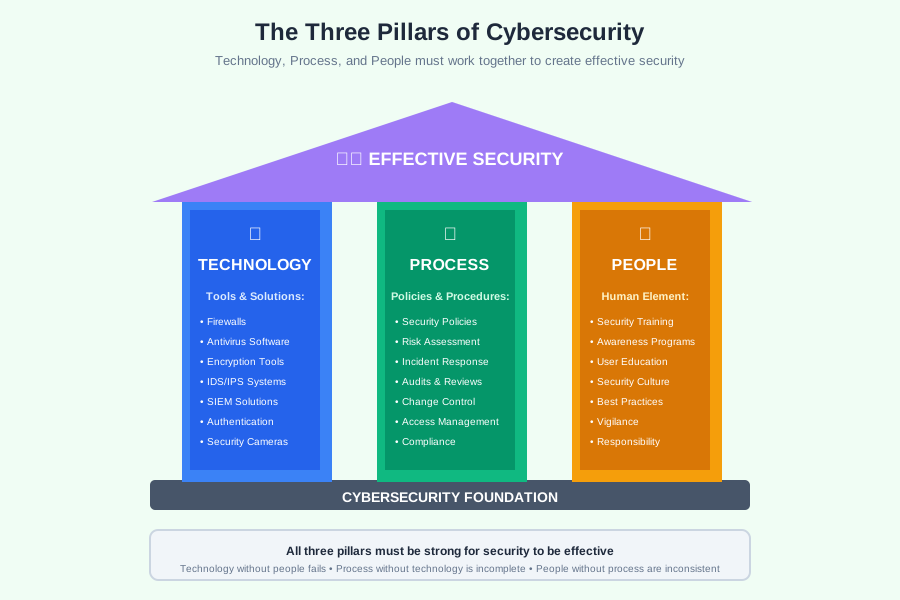
- ✅ Cybersecurity requires Technology + Process + People
- ✅ The CIA Triad is the foundation of all security
- ✅ 100% security is impossible—focus on risk management
- ✅ Humans are the weakest link—education is critical